
Pharmaceutical Compliance Translation: Precision for Global Regulatory Success
Pharmaceutical compliance translation ensures that regulatory documentation meets the exact requirements of health authorities across multiple jurisdictions. Pharmaceutical companies operating in the EU, US, and other regulated markets face stringent translation requirements that directly affect product approval timelines and market access.
Table of Contents
What Pharmaceutical Compliance Translation Delivers
Pharmaceutical compliance translation converts regulatory documentation into target languages while maintaining full alignment with the requirements of health authorities such as the EMA, FDA, and national regulatory agencies. Unlike general medical translation, compliance-focused work requires precise adherence to official terminology databases, formatting templates, and validation protocols specified by regulators.
The stakes are substantial. Translation errors in regulatory submissions can trigger application rejections, requests for information that delay approval timelines, or post-market compliance issues that affect patient safety. Regulatory agencies examine translated documents with the same scrutiny applied to source materials, expecting identical precision across all language versions.
Core Elements of Pharmaceutical Compliance Translation
Compliant pharmaceutical translation involves several interconnected processes. Translators must reference controlled vocabularies such as MedDRA for adverse event terminology and EDQM Standard Terms for pharmaceutical substances. The EMA's QRD templates prescribe exact formatting for SmPCs and Patient Information Leaflets, requiring translators to match structure precisely across all EU languages.
ISO 17100 certification provides the quality framework that pharmaceutical companies require from translation partners. This standard mandates qualified translators, mandatory revision by a second linguist, and documented project management processes that create full traceability for regulatory audits.
Regulatory Frameworks Driving Translation Requirements
The EMA requires that all product information, including SmPCs, labelling, and PILs, be available in the official languages of each EU member state where a medicinal product is marketed. Companies submitting marketing authorisation applications through centralised, decentralised, or mutual recognition procedures must provide EMA-compliant regulatory translation that aligns with QRD templates and uses terminology consistent with official databases.
The FDA mandates that all documents submitted in support of drug applications be in English or accompanied by certified translations. Clinical trial documentation, IND submissions, and NDA dossiers require translations that preserve the exact meaning of source content without omission or interpretation. Rigorous quality control processes ensure that translated content meets these specifications.
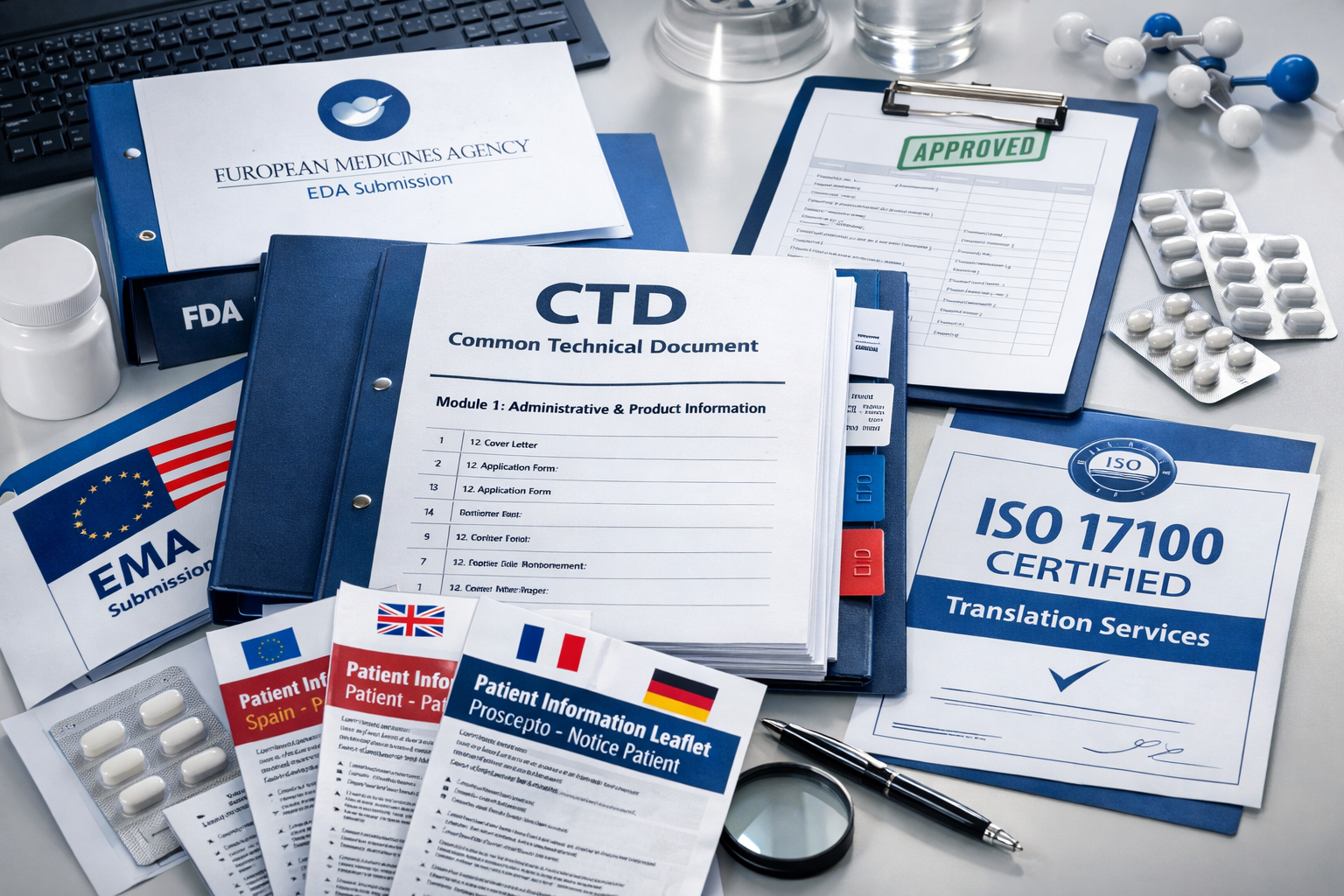
ICH guidelines, particularly the Common Technical Document format, have harmonised submission requirements across the EU, US, and Japan. The CTD structure requires consistent translation of Module 2 summaries, Module 3 quality documentation, and Module 5 clinical data across all target markets. This harmonisation simplifies the translation workflow while maintaining strict accuracy requirements.
Document Types Requiring Compliance Translation
Pharmaceutical compliance translation encompasses diverse document categories, each with specific regulatory requirements. Regulatory submission documents form the core of pharmaceutical regulatory translation work. These include CTD modules, clinical study reports, investigator brochures, and informed consent forms. Each document type has established conventions for terminology, structure, and presentation that translators must follow precisely.
Labelling and product information require particular attention. SmPCs provide prescribing information to healthcare professionals and must use standardised medical terminology consistently across all language versions. PILs communicate essential safety and usage information to patients, requiring clear language that maintains regulatory precision while ensuring comprehension.
Pharmacovigilance documentation presents unique challenges. Adverse event reports, periodic safety update reports, and risk management plans require rapid translation with maintained accuracy. The EMA's Good Pharmacovigilance Practices guidelines specify that ICSRs must include verbatim source text or accurate translations. Meeting tight reporting deadlines while ensuring terminological consistency demands experienced translators and efficient workflows.
Customised glossaries ensure terminology consistency across document types and projects. Building and maintaining client-specific terminology databases aligned with regulatory requirements reduces inconsistency risks and accelerates translation cycles.
Quality Standards for Pharmaceutical Translation
ISO 17100 certification establishes the baseline quality requirements for pharmaceutical compliance translation. The standard requires that translators possess formal qualifications in translation plus demonstrable subject matter competence. For pharmaceutical work, this means translators with backgrounds in life sciences, regulatory affairs, or clinical research.
The TEP process (Translation, Editing, Proofreading) mandated by ISO 17100 ensures that multiple qualified professionals review each translation. The translator produces the initial target text, a reviser compares it against the source for accuracy and completeness, and a proofreader checks the final output for linguistic quality. This multi-stage review catches errors that could trigger regulatory issues.
Beyond ISO 17100, pharmaceutical companies increasingly require translation services that can demonstrate GxP awareness. Understanding Good Manufacturing Practice, Good Clinical Practice, and Good Documentation Practice principles helps translators recognise the regulatory significance of specific terminology and formatting choices.
Quality metrics provide objective measures of translation performance. Accuracy rates, terminology consistency scores, and on-time delivery rates allow companies to evaluate translation partner performance against regulatory requirements. Regular quality audits ensure sustained compliance with agreed standards.
Selecting a Compliant Translation Partner
Pharmaceutical companies evaluating translation partners should prioritise several key criteria. ISO 17100 certification demonstrates commitment to quality processes and provides documentary evidence for regulatory audits. Experience with specific document types and regulatory pathways indicates capability to handle complex compliance requirements.
Terminology management capabilities matter significantly. Partners should maintain updated databases aligned with MedDRA, EDQM, and client-specific glossaries. Translation memory systems preserve previously approved translations for reuse, ensuring consistency across document versions and reducing turnaround times for updates.
Data security requirements are non-negotiable in pharmaceutical translation. Translation partners must implement appropriate measures to protect confidential information, including NDAs, secure file transfer protocols, and access controls that limit document visibility to authorised personnel only.
Understanding your project timelines and volume requirements helps identify partners with appropriate capacity. Regulatory submissions often involve large document volumes with fixed deadlines, requiring translation partners who can scale resources without compromising quality.
Ready to discuss your pharmaceutical compliance translation requirements? Request a quote for a detailed proposal tailored to your regulatory submission needs.